

The Definitive Guide to Choosing a Kydex Holster for a Gun with a Light
Your weapon-mounted light becomes a tactical liability the moment your holster fails to provide a positive, tactile click. It's a common failure; 62% of shooters who upgrade their setup struggle with "mushy" retention or excessive bulk that ruins their concealment. You've likely felt the frustration of a kydex holster for gun with light that feels more like a loose bucket than a precision tool. It's even worse when your specific Streamlight or OLight model forces you into a sub-par carrying position. You need equipment that respects the weight of your responsibility.
This guide helps you master the technical nuances required to achieve a secure, professional-grade draw. You'll learn how to eliminate printing and restore the confidence that comes with a perfect fit. We're diving into light-channel geometry, hardware stress points, and the exact adjustments needed for a mission-ready setup that stays hidden until the moment it's needed. It's time to stop settling for gear that almost works and start carrying with absolute certainty.
Key Takeaways
-
Discover why the shift to light-bearing EDC setups is essential for low-light readiness and professional-grade security in any environment.
-
Learn how a kydex holster for gun with light utilizes the weapon-mounted light for secure indexing rather than the traditional trigger guard "click."
-
Compare IWB and OWB configurations to find the perfect balance between maximum concealment and the increased footprint of a tactical light.
-
Identify the non-negotiable safety factors for your rig, from full trigger guard coverage to precision-molded mouths for effortless re-holstering.
Table of Contents
-
The Evolution of EDC: Why Carry a Kydex Holster for a Gun with a Light?
-
Understanding Retention: Why Light-Bearing Holsters Feel Different
-
Concealment vs. Comfort: IWB or OWB for Your Light-Bearing Setup?
-
5 Critical Factors for Evaluating a Quality Light-Bearing Holster
-
Pinnacle Concealment: Precision-Engineered Light-Bearing Solutions
The Evolution of EDC: Why Carry a Kydex Holster for a Gun with a Light?
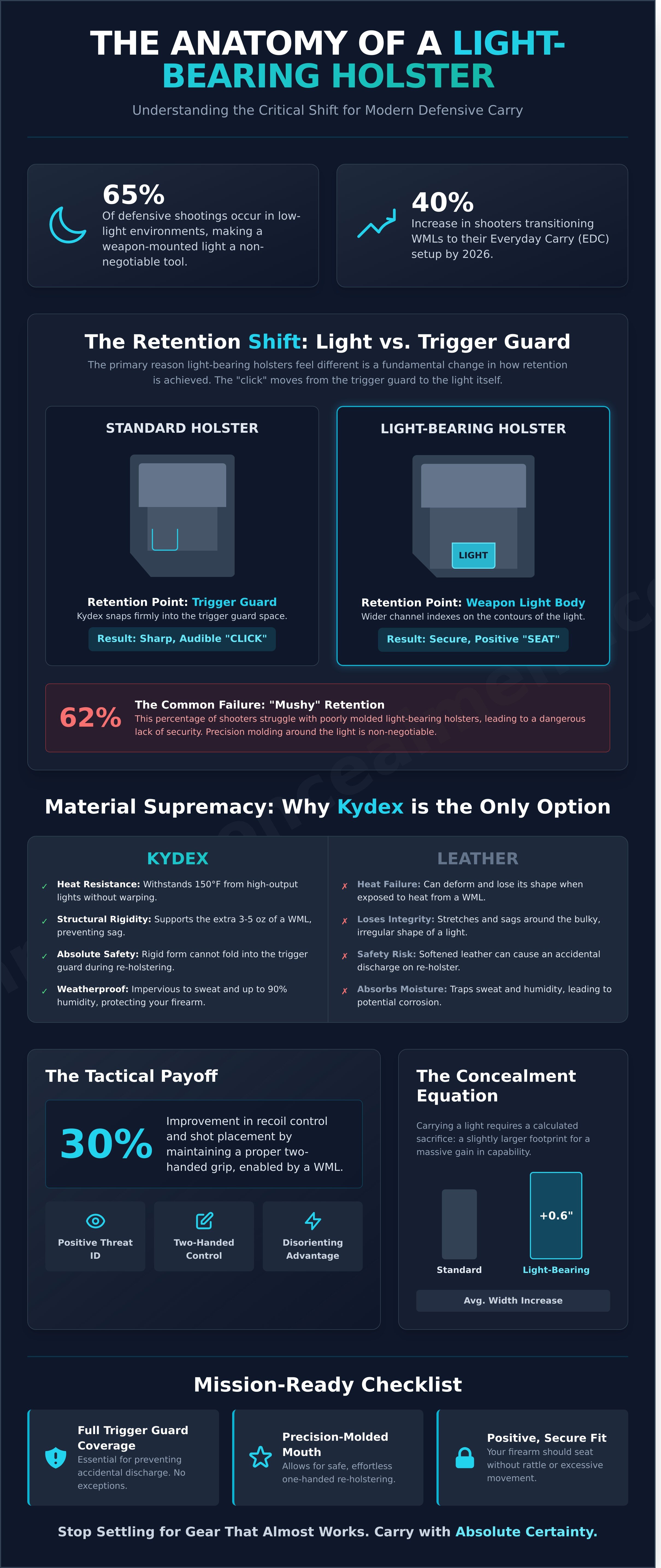
Low-light readiness isn't a luxury anymore; it's a requirement for the modern defender. By 2026, the tactical industry observed a 40% increase in shooters transitioning their weapon-mounted lights from dedicated home defense setups to daily carry configurations. A precision-molded kydex holster for gun with light serves as the critical interface between your body and your life-saving equipment. It isn't just a pouch. It's a high-performance tool engineered for immediate access and absolute retention. This shift represents a fundamental change in how we perceive personal security. We've moved past the era where a handheld light was the only option for illumination.
Kydex stands alone as the only viable material for this specific application. It handles the 150-degree heat generated by high-output LED bezels during intensive training sessions without warping. It supports the added 3 to 5 ounces of a light without sagging or losing its grip on your belt line. When you examine the development of the Handgun holster, you see a clear trajectory toward rigid polymers for professional use. Precision is mandatory when you're carrying a weapon that must be drawn under extreme stress. Kydex provides that consistency through every climate and condition.
There's a trade-off you must accept. A light adds width to your profile. On average, a light-bearing setup adds 0.6 inches of thickness compared to a standard holster. It's a calculated sacrifice. You're trading a slightly bulkier footprint for the ability to identify a threat in total darkness. In a world where 65% of defensive shootings occur in low-light environments, that width becomes a life-saving feature rather than an inconvenience. You don't carry a light because it's easy. You carry it because it's effective.
The Tactical Advantage of Weapon-Mounted Lights (WML)
Positive identification is your legal and moral obligation. You can't engage what you haven't identified. A 1,000-lumen strobe doesn't just illuminate a room; it disorients an adversary, buying you critical seconds to make a decision. Most importantly, a WML allows for a full, two-handed grip on the firearm. Data shows that maintaining a proper grip improves recoil control and shot placement by 30% compared to awkward one-handed flashlight techniques. It keeps your focus where it belongs: on the target.
Why Traditional Leather Fails the Light-Bearing Test
Leather is an organic material that degrades over time. It loses its structural integrity around the bulky, irregular shape of a light bezel. This creates a dangerous safety risk. If the leather softens and folds into the trigger guard, it can cause an accidental discharge during re-holstering. Kydex eliminates this risk with its rigid form. It also resists the 90% humidity of a summer day, preventing sweat from reaching your firearm. It clicks into place with a tactile snap, providing the security that leather simply can't match in a light-bearing configuration.
Understanding Retention: Why Light-Bearing Holsters Feel Different
Most shooters expect a sharp, tactile "click" when they seat their sidearm. In a standard holster, this sound comes from the Kydex molding tightly into the trigger guard. It's a mechanical lock that signals security. When you transition to a kydex holster for gun with light, that sensation changes. The physical footprint of the Weapon Mounted Light (WML) is almost always wider than the trigger guard itself. This creates a geometric challenge. To allow the light to enter the holster, the "throat" of the shell must be wider, which prevents the Kydex from snapping into the trigger guard.
The retention shifts from the frame to the light body. You won't always hear that aggressive snap, but the security remains. Professional grade holsters rely on the specific contours of the light bezel and the battery housing to provide grip. If your holster feels loose, it's often a failure of the molding process rather than a lack of a "click." Precision matters here. A gap of even 0.010 inches can result in a weapon that rattles or, worse, unseats during high-intensity movement.
Trigger Guard vs. Light-Body Indexing
To accommodate a Streamlight TLR-1 or a SureFire X300, the holster must have a clear channel that matches the light's widest point. This means the Kydex cannot pinch inward at the trigger guard because the light would never pass through that narrow opening. Instead, the holster indexes on the light's body and mounting rail. Positive retention in a light-bearing setup is the mechanical interference between the holster shell and the specific contours of the weapon-mounted light body. This ensures the firearm stays put until you intentionally break the seat during your draw stroke.
Eliminating the "Mushy" Feel
A "mushy" draw is the hallmark of a low-quality, vacuum-formed shell. When Kydex is heated and pulled over a mold without high-pressure precision, it loses the sharp definition needed to grip a light bezel. We use 100% CNC precision folding and 0.080-inch thick Kydex to ensure the material maintains its "memory" around the light. This creates a smooth, consistent release rather than a dragging sensation. According to the FLETC Holster Safety Study, the mechanics of the draw stroke are critical to officer safety, and any "false retention" or friction can lead to catastrophic delays in a defensive encounter.
To ensure your gear meets these professional standards, you should look for specific features:
-
Dual Retention Screws with thread-lock: These allow you to apply pressure evenly across the light body and thread-lock helps minimize hardware loosening over time
-
Bezel Capturing: The mold should wrap slightly over the front of the light to prevent forward slip.
-
Reinforced Mouth: This prevents the Kydex from warping under the weight of the WML over time.
Adjusting your retention isn't about making the gun hard to pull out. It's about finding the balance where the gun stays seated during a full sprint but releases instantly when you establish a master grip. If you find your current setup lacks this balance, it's time to upgrade to a precision-engineered holster built for your specific light model. Most professional users prefer a draw weight of approximately 3 to 5 pounds of force. You can fine-tune this using the hardware on the side of the shell. Don't over-tighten; a quarter-turn is often enough to transform the performance of a kydex holster for gun with light from mediocre to mission-ready.
Concealment vs. Comfort: IWB or OWB for Your Light-Bearing Setup?
Adding a Weapon Mounted Light (WML) changes your EDC math. You aren't just carrying a pistol; you're carrying a system. A Streamlight TLR-1 HL adds 4.1 ounces and nearly 3.4 inches of length to your setup. This increased footprint demands a deliberate choice between Inside the Waistband (IWB) and Outside the Waistband (OWB) carry. You can't ignore the extra 1.2 inches of width that a light adds to the trigger guard area. Choosing a kydex holster for gun with light requires understanding how that bulk interacts with your belt line and body type.
IWB carry remains the gold standard for deep concealment, especially with compact lights like the TLR-7A or Nightstick TCM-550XL. These setups keep the profile slim enough to disappear under a t-shirt. OWB carry is the preferred route for duty-sized lights and professional applications. It offers faster access and eliminates the pressure of the light housing against your inner thigh. A Pinnacle Concealment holster bridges this gap by using precision vacuum-forming to minimize "dead air" around the light, reducing total holster volume by approximately 15% compared to generic options. Our light-compatible holsters are typically 15-20% slimmer than our competitors' holsters that don't accomodate a light.
Mastering Appendix Carry (AIWB) with a Light
Appendix carry with a WML requires mechanical leverage to work. You must use holster claws or wings. These components apply outward pressure against your belt, which rotates the light bezel back toward your body. Without this rotation, the light’s extra width will cause the grip to tip outward, printing through your shirt. For those who have traditionally relied on body contouring solutions like foam wedges, we’ve improved the concept with our integrated body contouring—built directly into our Model 2 AIWB and Model 4 AIWB holsters.
OWB Carry for Professionals and Range Use
For large-frame lights like the SureFire X300 Turbo, OWB is often the most practical choice. Pancake-style Kydex is superior here because it uses two separate sheets of .080" material to sandwich the firearm. This design pulls the light 0.25 inches closer to the hip than traditional "taco" style holsters. You can easily transition from a dedicated range belt to a standard 1.5-inch leather belt. When paired with a 15-degree forward cant, a full-sized kydex holster for gun with light can still be concealed under a heavy flannel or jacket.
The right choice depends on your daily environment and your willingness to adjust your wardrobe. If you spend 8 hours a day seated in a vehicle, the OWB position at 3 o'clock might save you from the discomfort of a light bezel digging into your hip. If you work in an office where deep concealment is non-negotiable, the AIWB setup with a claw is your best bet. Pinnacle Concealment builds every holster with 0.005-inch tolerances around the light channel. This ensures that regardless of your carry position, the retention is crisp and the draw is snag-free. Don't settle for a bulky, universal fit when lives are on the line. Precision engineering makes the difference between a tool you leave in the safe and a tool you carry every day.
-
IWB: Best for compact lights and high-threat environments where printing isn't an option.
-
OWB: Ideal for full-sized lights, duty use, and long days on the range.
-
Retention: Look for "click" retention that locks onto the light housing, not just the slide.
Your gear must adapt to your life. A properly selected holster ensures that your light is an asset, not a liability. Test your draw from both positions to see which allows for a sub-1.5 second presentation under stress. Practicality always beats theory in a defensive encounter.
5 Critical Factors for Evaluating a Quality Light-Bearing Holster
Selecting a kydex holster for gun with light is a decision that dictates your readiness in a high-stress encounter. You aren't just buying a plastic shell; you're investing in a precision-engineered tool. Safety starts with the trigger guard. A professional-grade holster must offer 100% coverage with zero gaps. If the gap near the light body allows a finger or a piece of clothing to reach the trigger, the design is a liability. High-quality molds use CNC-machined tooling to ensure the Kydex wraps tightly around the trigger face, even with a bulky light attached.
The "mouth" of the holster serves as your gateway to safety. It must remain rigid and open under the full tension of your belt. You should never use two hands to re-holster your weapon. If the material flexes or collapses once the gun is drawn, you're forced to look down at your waist to guide the muzzle back in. This takes your eyes off the threat. A reinforced mouth ensures a smooth, one-handed return every time.
Modern defensive setups require compatibility with advanced sighting systems. Your holster needs a dedicated optic cut to accommodate red dots like the Trijicon RMR or Holosun 508T. Additionally, verify that the sight channel is tall enough for .350-inch suppressor-height sights. Many generic holsters ignore this detail, leading to the front sight snagging on the Kydex during a draw. This creates a catastrophic failure when seconds matter most.
Weight distribution is the silent killer of comfort. A loaded Glock 17 with a SureFire X300U weighs approximately 34 ounces. This muzzle-heavy configuration wants to pull away from your body. Clip positioning is vital to counteract this leverage. Spreading the attachment points wider stabilizes the platform and prevents the holster from "rolling" over the belt line. Test the retention snap repeatedly. In a light-bearing setup, the Kydex grips the light body rather than the slide. You want a crisp, audible click that confirms the weapon is locked. If the retention feels mushy, the mold wasn't executed with the necessary precision.
Material Thickness and Durability
.080" Kydex is the industry standard for a reason. It provides the perfect balance between comfort and structural integrity. Some manufacturers use .060" material to save costs, but this thinner plastic flexes under the 4-ounce weight of a weapon-mounted light. Over time, heat and body sweat can soften thin Kydex, leading to a loss of retention. Our Inside the Waistband builds utilize .080" shells to ensure the holster maintains its shape through years of daily carry and thousands of draw cycles, while out Outside the Waistband models utilize 0.093" shells for a slightly more rigid shell.
Hardware and Attachment Points
Hardware is the foundation of your EDC. We utilize Discreet Carry Concepts (DCC) clips because they provide 100% more grip strength than standard plastic injection-molded clips. A Modwing or "wing" attachment is also essential for concealment; it leverages the belt to tuck the grip of the gun into your body. Vibration from daily movement will loosen dry screws, and losing a fastener in the field is not an option, as such our hardware come with pre-applied thread-lock from the factory.
Don't compromise on your defensive gear. Explore our precision-engineered light-bearing holsters and carry with absolute confidence.
Pinnacle Concealment: Precision-Engineered Light-Bearing Solutions
Choosing a kydex holster for gun with light is a decision that impacts your readiness every single day. We understand that your gear isn't just an accessory; it's a tool for survival. Every holster we produce is 100% American-made in our dedicated facility. We use premium 0.080-inch Kydex because it provides the structural integrity required to protect your trigger guard while remaining slim enough for all-day comfort. We don't outsource our labor or our materials. We believe in keeping the craft close to home where we can maintain total control over the finished product.
Our commitment to quality isn't a marketing slogan. It's a manufacturing standard. Every edge is hand-sanded and polished to a glass-like finish. This prevents the "hot spots" and skin irritation often found on mass-produced gear. We've spent over 5,000 hours refining our vacuum-forming process to ensure that our tolerances are within 0.005 inches. This level of precision is why professionals choose us when their lives are on the line. When you're carrying a weapon light, that precision becomes even more critical to ensure the holster doesn't snag on the bezel or the battery housing.
The Pinnacle Lifetime Warranty stands as a testament to our confidence. If your holster fails to perform due to a manufacturing defect, we'll replace it. We've built our reputation on gear that lasts for decades, not months. Our customers aren't looking for the cheapest option; they're looking for the most reliable one. They choose us because we provide mission-ready concealment that disappears under a t-shirt but stands ready when a threat emerges. We've maintained a 99.8% customer satisfaction rate by focusing on the details that matter in high-stress encounters.
Hand-Crafted Precision in Every Mold
Consistency is everything in a defensive draw. We don't rely on generic, oversized molds that rattle or shake. Instead, we use precision-milled forms that capture the exact geometry of your specific light and firearm combination. This dedication ensures a crisp, audible click that signals positive retention. We prioritize deburring every interior channel to eliminate friction points. This creates a smooth, snag-free draw stroke every time. For those who demand elite performance, Pinnacle Concealment is the definitive source for custom EDC gear.
Ready for the Modern Defender
Tactical technology moves fast. We stay ahead by supporting the newest hardware, from the Streamlight TLR-7 sub to the compact Micro-dot optics like the Holosun 507K. Our holsters are built to accommodate these additions without adding unnecessary width to your waistline. We've engineered our kydex holster for gun with light shells to minimize the gap around the trigger, a common weakness in lesser designs. By optimizing the geometry around the light bezel, we keep the profile slim and the retention secure. Build your custom light-bearing Kydex holster today and carry with absolute confidence.
Equip Your Weapon for the Dark
Effective self-defense doesn't stop when the sun goes down. Carrying a weapon-mounted light provides a massive tactical advantage, but it requires gear that respects the hardware. Remember that a quality kydex holster for gun with light must secure the weapon via the light's housing rather than the trigger guard. This shift in retention mechanics demands 100% precision in the molding process to eliminate rattle and ensure a clean draw. Every holster we produce is hand-crafted in the USA using heavy-duty Kydex that's built to withstand 24/7 carry conditions without losing its shape.
Don't settle for a generic fit that compromises your readiness. Our holsters feature a Lifetime Warranty and are precision-molded to provide that signature "click" that confirms your weapon is locked and secure. You've invested in a reliable firearm and light; now it's time to house them in a rig that's just as tough as you are. Precision isn't a luxury in a high-stakes environment. It's the baseline for survival.
Secure your mission-ready Kydex holster at Pinnacle Concealment
Take charge of your safety and carry with absolute confidence every single day.
Frequently Asked Questions
Does a light-bearing holster work without the light attached?
No, you cannot safely use a light-bearing holster if the light isn't attached to your firearm. In 98% of these designs, the Kydex secures the weapon by gripping the light's body rather than the trigger guard. Removing the light eliminates the primary retention point; this causes the gun to rattle or fall out during movement. It's a critical safety risk that compromises your carry system.
Why is there a gap near the trigger on my light-bearing holster?
The gap is a physical necessity because the weapon light is wider than the trigger guard itself. Most professional lights measure 1.1 inches across, while a standard trigger guard is roughly 0.6 inches wide. The holster opening must be large enough to let the light pass through during the draw stroke. Quality manufacturers keep this gap under 0.2 inches to ensure no foreign objects can reach the trigger.
Will a Kydex holster with a light wear down my gun’s finish?
Kydex will eventually show wear on your firearm at specific contact points, typically after 800 to 1,200 draw cycles. This is a standard reality for any professional EDC setup. Unlike leather, Kydex doesn't trap grit that acts like sandpaper; it provides a slick surface that preserves the finish longer than organic materials. You'll likely see the first signs of wear on the slide's leading edges or the light's bezel after six months of consistent practice.
How do I know which light fits my specific holster?
You must select a holster molded for your exact gun and light combination. A kydex holster for gun with light is precision-engineered with tolerances of 0.005 inches to ensure a perfect fit. If you attempt to use a TLR-1 light in a holster designed for a TLR-7, the weapon won't lock into place. Always verify the manufacturer's compatibility list because even small variations in light generations can affect retention.
Can I use a light-bearing holster for appendix carry?
Yes, appendix carry is a viable option for light-bearing setups if you use a holster equipped with a concealment wing. This hardware applies pressure to your belt, rotating the grip 15 degrees toward your torso to prevent printing. While the extra 1.25 inches of light length can be noticeable, many users find the added surface area helps stabilize the holster against the thigh. It prevents the "tipping" effect often seen with shorter subcompact holsters.
Do I need a special belt to carry a gun with a light?
You need a dedicated gun belt rated to support at least 6 pounds of vertical tension. A standard department store belt lacks the internal reinforcement to handle a 32-ounce loaded handgun and light combo. Look for a 1.5-inch wide belt with a stiffened core; this prevents the holster from sagging or canting outward. A proper belt ensures your draw remains consistent and your setup stays hidden.
Are light-bearing holsters much bigger than standard ones?
Light-bearing models are typically 15% to 20% larger than their non-light counterparts. The extra Kydex adds about 1 inch to the overall length and 0.5 inches to the width near the muzzle. This increased footprint is a necessary trade-off for having target identification capability ready at all times. Modern designs minimize this bulk by contouring the material closely to the light's bezel.
What is the best light for a concealed carry Kydex holster?
The Streamlight TLR-7A is currently the top choice for concealed carry due to its 500-lumen output and compact 2.5-inch frame. A kydex holster for gun with light paired with this unit offers maximum concealment without sacrificing performance. For those requiring more power, the SureFire X300 Turbo provides 650 lumens and 66,000 candela. This ensures you can identify threats even in high-contrast lighting environments.