

The Colt 1911: A Comprehensive Guide to History, Performance, and Modern Carry in 2026
A century of polymer innovation hasn't managed to retire the steel-framed legend that defined 20th-century combat. The colt 1911 remains the premier choice for shooters who demand a crisp 4-pound trigger pull and a platform that points as naturally as a finger. You know that carrying a full-sized pistol presents real challenges. You’ve likely felt the 39-ounce weight of a Government model straining your belt or struggled to keep the 5-inch barrel from printing through your clothing.
Our guide will show you how to master this legendary weapon using 2026 concealment technology and precision-engineered gear. You'll learn why this platform is still worth the investment and how to choose between the 5-inch Government and the 4.25-inch Commander models for your specific mission. We’ll break down the mechanics of modern reliability and show you the exact carry techniques required to make this heavy-hitting classic a comfortable part of your daily EDC setup.
Key Takeaways
-
Trace the 115-year evolution of the colt 1911 to understand why it remains the gold standard for self-defense in 2026.
-
Compare the Government, Commander, and Defender models to identify the ideal frame size and material for your specific mission.
-
Learn to leverage the legendary 18-degree grip angle and single-action trigger for unmatched speed and accuracy.
-
Discover professional strategies for managing the weight and dimensions of a full-sized steel frame during daily carry.
-
See why precision-molded Kydex is the only way to ensure consistent retention and a secure "click" fit for your sidearm.
Table of Contents
-
The Legacy of the Colt 1911: Why It Remains the Standard in 2026
-
Carrying a Legend: Overcoming the Challenges of 1911 Concealment
-
Precision Carry Solutions: The Pinnacle Concealment Difference
The Legacy of the Colt 1911: Why It Remains the Standard in 2026
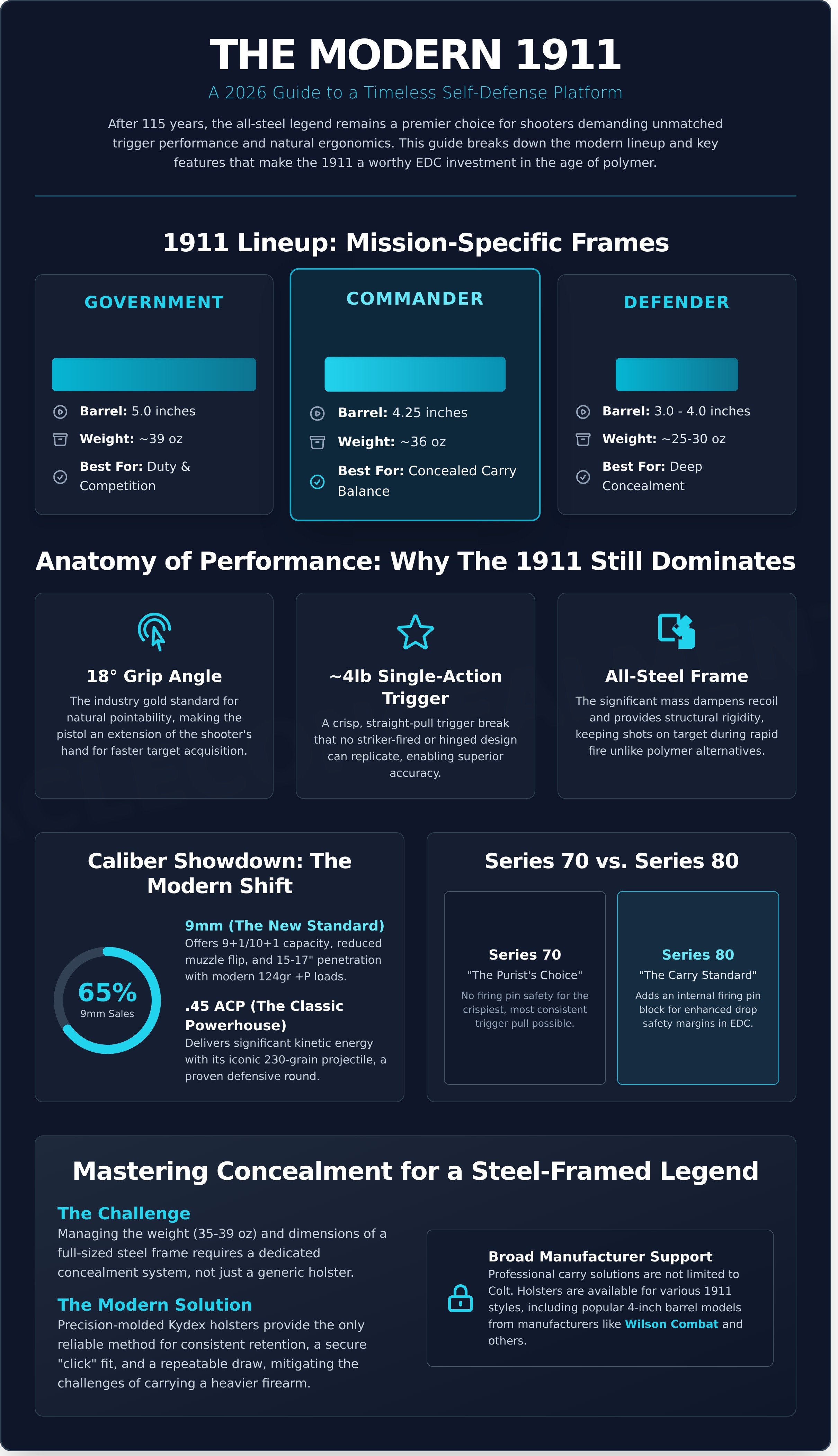
The 1911 isn't just a firearm; it's a mechanical masterwork that has survived over a century of combat, competition, and civilian use. John Moses Browning finalized the design in 1911, and since that date, the colt 1911 has served as the definitive sidearm for American forces through two World Wars and dozens of global conflicts. Its 115-year evolution from a rugged trench tool to a refined everyday carry option proves that its fundamental engineering is flawless. While polymer-framed striker-fired pistols dominate the budget market in 2026, the all-steel construction of a genuine Colt provides a level of recoil dampening and structural rigidity that synthetic materials cannot replicate.
Carrying a pistol with the Colt name engraved on the slide carries a psychological weight that clones rarely achieve. It represents a direct lineage to the original military contracts that forged the American century. For the serious practitioner, this choice isn't about nostalgia. It's about the confidence that comes from a platform tested in the mud of the Meuse-Argonne and the sands of Iwo Jima. You can study the M1911 pistol history to see how this single-action design set the blueprint for nearly every semi-automatic handgun that followed. The 1911 doesn't apologize for its weight; it uses that mass to stay on target for follow-up shots when every millisecond counts.
-
Proven Ergonomics: The 18-degree grip angle remains the industry gold standard for natural pointability.
-
Unmatched Trigger: The straight-pull trigger allows for a 4.0-pound break that no hinged or striker design can match.
-
All-Steel Durability: A forged steel frame handles tens of thousands of rounds without the frame flex found in polymer alternatives.
-
Legacy of Performance: Over 2.7 million units were produced for the U.S. military alone before its official retirement as the primary sidearm in 1985.
The Series 70 vs. Series 80 Debate
The choice between Series 70 and Series 80 configurations defines the colt 1911 experience for many owners. Series 70 models lack a firing pin safety, which results in a crisper, more consistent trigger pull that purists demand. The Series 80, introduced in 1983, added a mechanical block to prevent accidental discharge if the weapon is dropped. For modern defensive carry in 2026, many professionals choose the Series 80 for its enhanced safety margins, though a properly tuned Series 70 remains the king of the firing line.
The Allure of the .45 ACP and the 9mm Shift
In 2026, the debate between .45 ACP and 9mm focuses on efficiency rather than "stopping power" myths. The .45 ACP remains a powerhouse, pushing a 230-grain projectile that delivers significant kinetic energy. However, 9mm 1911 models now account for approximately 65% of new sales. Modern 9mm defensive loads like 124-grain +P rounds offer penetration depths of 15 to 17 inches in ballistic gelatin. This caliber shift allows for a 9+1 or 10+1 capacity in a standard frame while significantly reducing muzzle flip during rapid fire.
Choosing a 1911 is a commitment to a standard of excellence. It requires more maintenance than a plastic disposable, but it offers a ceiling of performance that those tools can never reach. When your life depends on a single press of the trigger, the heritage of the Colt platform provides the certainty required for the mission.
Understanding the Modern Colt 1911 Lineup
The modern Colt 1911 catalog is a masterclass in functional diversity. It isn't just about nostalgia; it's about mission-specific engineering. Colt utilizes forged components to maintain a standard of durability that cast frames simply can't match. Carbon steel remains the choice for traditionalists who value a classic blued finish. Stainless steel offers a necessary upgrade for those living in humid climates or carrying daily, as it resists the salt and sweat that corrode lesser metals. For the dedicated EDC practitioner, lightweight aluminum frames have changed the math, reducing the burden for those who carry for 10 or 12 hours straight.
The Classic series occupies a unique space in a market dominated by polymer pistols. While striker-fired guns focus on high capacity and low weight, the modern Colt M1911 manufacturing process prioritizes a crisp, single-action trigger and a slim profile. Specialized models like the Gold Cup and the Competition Series push these limits further. These firearms feature National Match barrels and wide triggers designed for 1-inch groups at 25 yards. They're built for speed and precision, using G10 grips and adjustable sights to ensure the shooter stays on target during rapid strings of fire.
Government vs. Commander: The Carry Trade-off
Deciding between the Government and Commander models is a choice between ballistic efficiency and concealment. The Government model features a 5-inch barrel, providing a longer sight radius and maximum velocity for the .45 ACP or 9mm rounds. This 0.75-inch difference in barrel length might seem small, but it changes the balance of the weapon entirely. The Commander uses a 4.25-inch barrel, which clears the holster faster and sits more comfortably when seated. Many modern shooters opt for bobtail frame conversions on their Commander models to eliminate the sharp corner of the grip that often prints through a shirt.
The Defender: Deep Concealment in a 3-inch Package
Deep concealment once meant sacrificing reliability, but the Colt 1911 Defender changed that narrative. Engineering a 3-inch barrel 1911 requires solving complex timing issues. Colt addressed this with a dual-spring recoil system that manages the increased slide velocity. An aluminum-framed Defender weighs approximately 24 ounces, representing a 30% weight reduction compared to a steel Government model. This makes it an ideal candidate for all-day carry. When you pair the Defender with a high-retention AIWB holster, you gain a platform that disappears under a light t-shirt while maintaining the stopping power of a full-sized caliber. It's a professional tool for those who refuse to compromise on their defensive capabilities.
Your gear must match your commitment to self-defense. Explore our precision-molded holsters to find a carry solution that is as rugged and reliable as your Colt.
The Anatomy of Performance: Why the 1911 Design Still Wins
The colt 1911 isn't a relic of the past; it's a precision tool that remains relevant in 2026. Its longevity stems from John Browning’s original design, which prioritized the human interface long before "ergonomics" became a marketing buzzword. The 18-degree grip angle remains the industry gold standard for natural pointability. When you punch the gun out toward a target, the sights align with your eye instinctively. You don't fight the frame to find your sight picture. This geometry ensures that the recoil impulse travels straight back into the meat of the hand, reducing muzzle flip and allowing for faster follow-up shots.
The single-action trigger is the soul of the platform. Unlike striker-fired pistols that often feel "mushy" or have significant "creep," the 1911 offers a crisp, glass-like break. Most professional duty setups hover between a 3.5 and 4.5-pound pull weight. This short, tactile reset allows a disciplined shooter to achieve split times under 0.20 seconds. Speed and accuracy aren't trade-offs here. They're built into the sear engagement. This mechanical advantage is why the 1911 remains the benchmark against which every modern combat handgun is measured.
While modern polymer "bricks" prioritize capacity, they often sacrifice concealability. A standard colt 1911 slide measures roughly 0.9 inches wide. This slim profile allows the pistol to disappear against the body in an IWB holster. Even with a full 5-inch Government barrel, the flat geometry reduces "printing" more effectively than many sub-compact double-stacks. You get a full-sized sight radius and a complete grip in a package that's barely an inch thick.
Mechanical reliability has reached its peak thanks to modern manufacturing. In the early 20th century, these pistols required significant hand-fitting. Today, CNC machining and aerospace-grade tolerances ensure that every component cycles with surgical consistency. According to A History of the Colt 1911, the platform’s combat record across two World Wars proved its resilience in the mud of France and the sands of the Pacific. Modern metallurgy has only made the cycle smoother and the parts more durable.
Mastering "Condition One" Carry
Carrying "Cocked and Locked" is the professional standard for this platform. It means a round is chambered, the hammer is back, and the manual safety is engaged. This setup provides two redundant mechanical safeties that work in tandem. The grip safety prevents the gun from firing unless you have a firm, intentional purchase on the weapon. The manual thumb safety locks the sear directly. A precision Kydex holster adds a third layer of security. It covers the trigger guard completely and keeps the thumb safety pinned in the "on" position during high-intensity movement.
The Modern 2011 Evolution
The 2011 is the logical progression of Browning’s vision for the 21st century. It retains the classic controls but utilizes a modular frame to accept double-stack magazines, jumping capacity from 8 rounds to 17 or 20. The Staccato HD C4X represents the peak of this evolution, blending duty-grade ruggedness with the performance of a race gun. Because these frames are wider and often include accessory rails, holster fitment is critical. You need a shell molded to the exact dimensions of the oversized grip and light rail to ensure the retention is secure and the draw is clean.
Carrying a Legend: Overcoming the Challenges of 1911 Concealment
Choosing to carry a colt 1911 in 2026 is a statement of confidence. It's also a significant physical commitment. A standard steel-frame Government model weighs approximately 39 ounces empty. Once you load eight rounds of 230-grain .45 ACP, that weight climbs to nearly 43 ounces. For comparison, a modern polymer-framed pistol weighs roughly 30 percent less. You can't ignore 2.7 pounds of steel hanging from your waist. Without the right gear, that weight causes the holster to sag, pulling your belt down and creating hotspots on your hip by mid-afternoon.
The solution starts with a dedicated gun belt. A standard leather belt from a department store will fail within a week. You need a 1.5-inch or 1.75-inch reinforced belt designed to handle high-mass firearms. These belts use internal stiffeners, often made of polymer or spring steel, to distribute the weight around your entire waistline rather than letting it concentrate on a single point. This rigidity keeps the 1911 vertical and prevents the grip from tipping outward, which is the primary cause of printing.
Physics plays a major role in concealing the Government model's 5.7-inch height. While the 5-inch barrel is easy to hide inside the pants, the full-size grip naturally wants to poke through cover garments. Your body type dictates the best carry position. Thinner users often find success at the 3 o'clock position, while those with a broader build may prefer the 4 or 5 o'clock positions where the natural hollow of the lower back hides the frame. Success depends on the holster's "cant" or tilt. A 15-degree forward tilt moves the grip upward and forward, aligning it with the natural curve of your ribs.
IWB and AIWB for the 1911
Inside the Waistband (IWB) carry is the most effective way to hide a colt 1911 under a simple t-shirt. Modern Kydex designs utilize "claws" or "wings" to solve the grip-printing problem. These attachments sit near the belt line and use the tension of the belt to lever the grip inward toward your body. For those prioritizing front-carry concealment, the Model 2 AIWB provides the specific geometry needed to tuck a full-size frame into the inguinal crease. To stay comfortable while sitting, pull your belt up slightly before you drop into a chair. This small adjustment prevents the 5-inch slide from digging into your thigh.
OWB: The Choice for Range and Duty
Outside the Waistband (OWB) carry offers the fastest draw stroke and maximum comfort. It's the preferred method for professional duty or long days at the range. The Model 5 OWB Quick Detach allows you to mount or remove the holster without unthreading your belt, providing professional-grade utility for rapid transitions. To conceal an OWB 1911, you need a high-ride holster that keeps the muzzle above the hem of a standard jacket or untucked flannel shirt. This setup excels in colder climates where layers are common, providing a reliable draw that isn't hampered by tight internal waistbands.
Ready to carry your 1911 with absolute confidence? Shop our professional-grade holster collection here.
Precision Carry Solutions: The Pinnacle Concealment Difference
Carrying a colt 1911 in 2026 requires gear that matches the weapon's legendary reliability. Traditional leather holsters often fail because they lose structural integrity over time. After 12 to 18 months of daily carry, leather softens. This creates a safety risk where the holster material can ingress into the trigger guard. Kydex eliminates this variable. We use .080" thickness Kydex to provide a rigid, non-collapsible shell that maintains its shape regardless of temperature or moisture levels. This consistency ensures your draw stroke remains identical every time you reach for your sidearm.
Our hand-crafted process focuses on mechanical retention. We don't rely on friction alone. Every holster is molded to the specific geometry of your 1911 model. You'll feel and hear a distinct "click" when the firearm is fully seated. This audible feedback confirms that the trigger is completely shielded and the weapon is secure. It's a level of precision that mass-produced plastic holsters can't replicate. We build these tools for professionals who understand that a 42-ounce steel pistol requires a foundation that won't sag or shift during high-intensity movement.
Durability is the cornerstone of our design philosophy. We use corrosion-resistant stainless steel hardware and heavy-duty belt attachments tested to withstand 50 pounds of upward force. Every edge is hand-buffed to prevent "hot spots" against your skin. We're so confident in our American-made craftsmanship that we provide a lifetime guarantee. If your gear fails, we fix it. It's that simple. We believe an American icon deserves a holster built with the same level of commitment to excellence.
Customization for Your Specific 1911
Modern 1911s have evolved beyond the standard GI specs. Our holsters accommodate 1913 Picatinny rail sections, red dot optics like the Trijicon RMR, and extended threaded barrels. We include adjustable retention screws so you can fine-tune the "break" of your draw. A critical feature for the colt 1911 is our integrated full-length sweat guard. Since carbon steel can begin to oxidize at 60% humidity, our guard creates a physical barrier between your body and the slide, protecting your finish from salt and moisture.
Ready for the Mission
Your holster isn't just an accessory; it's a life-saving component of your weapon system. It's the most important purchase you'll make after the firearm itself. Before you head out, use this final checklist for your carry setup:
-
Verify that the optic clear's the holster mouth without snagging.
-
Test the retention by inverting the holster (with an unloaded firearm) over a soft surface.
-
Check that the belt clips are securely tightened to your carry belt.
-
Ensure the sweat guard doesn't interfere with a full firing grip.
Don't compromise on the final link in your self-defense chain. A world-class pistol is only as effective as your ability to deploy it safely and quickly. Upgrade your carry with a Pinnacle Concealment 1911 Holster today and experience the standard of professional-grade protection.
Master Your Carry Setup for 2026
Over 115 years of field-tested history proves that this platform isn't just a relic; it's a functional masterpiece that still dominates the firing line in 2026. You've seen how modern engineering and 0.001-inch machining tolerances have refined John Browning's original design for the modern era. Carrying a 39-ounce sidearm daily requires a commitment to quality gear that eliminates printing and maximizes comfort. We don't believe in universal fits or mass-produced compromises that fail when the stakes are high. At Pinnacle Concealment, we provide the engineering your mission demands through gear that's built for the long haul. Every holster is hand-crafted in the USA and precision-molded for perfect retention, ensuring your weapon stays secure until the moment you need it. We back every product with a Lifetime Warranty because your safety is a permanent responsibility, not a temporary convenience. It's time to upgrade your EDC setup with equipment that's as reliable as your sidearm. Take the final step in your tactical preparation today. Find the perfect Kydex holster for your colt 1911 and step out with the confidence of a professional.
Frequently Asked Questions
Is the Colt 1911 too heavy for everyday carry?
Carrying a steel Colt 1911 isn't too heavy if you use a reinforced 1.5 inch gun belt. A standard government model weighs 39 ounces empty. If that feels excessive, the Lightweight Commander reduces weight to 29 ounces using an aluminum frame. Modern holster designs distribute this weight across your hip to prevent sagging. You'll feel the weight, but it serves as a constant reminder of your readiness.
What is the difference between a Series 70 and Series 80 Colt 1911?
The primary difference is the internal firing pin safety introduced in 1983 for the Series 80. This mechanism prevents the gun from firing if dropped, but it slightly increases trigger pull weight. Series 70 models lack this block and provide a crisper, 4.5 pound trigger break. Most purists prefer the Series 70 for its simpler design and superior tactile feedback during rapid fire sequences.
Can I carry a Colt 1911 in a Kydex holster without damaging the finish?
Every Kydex holster causes finish wear at specific contact points like the trigger guard and muzzle. This is a reality of daily carry. A precision-molded holster minimizes movement, which reduces the rate of abrasion. If you draw your weapon 1,000 times during dry-fire practice, expect the bluing to thin. Use a holster with adjustable retention to keep the fit tight and the friction localized.
Which Colt 1911 model is best for concealed carry?
The Colt Defender is the best choice for deep concealment because of its 3 inch barrel and compact frame. It weighs 24 ounces, making it 15 ounces lighter than a full-sized steel model. If you prefer a full-sized grip, the Lightweight Commander offers a 4.25 inch barrel. Both models provide the reliability needed for personal defense while remaining slim enough to disappear under a standard t-shirt.
Is "Condition One" (Cocked and Locked) carry safe for beginners?
Condition One is safe for any shooter who respects the four rules of firearm safety. The Colt 1911 features a manual thumb safety and a grip safety that both must be engaged to fire. This dual-redundancy has protected users for 115 years. Carrying with an empty chamber slows your response time by 1.5 seconds in a life-threatening encounter. Train until the thumb safety sweep becomes muscle memory.
Does a Colt 1911 fit in a 2011 holster?
A standard 1911 won't fit properly in a 2011 holster because the frame dimensions differ. The 2011 platform is roughly 0.2 inches wider to accommodate double-stack magazines. This extra width prevents the Kydex from clicking onto the trigger guard of a slim Colt. Always use a holster molded specifically for your model's slide length and rail configuration to ensure 100 percent retention.
Why should I choose a Colt over a cheaper 1911 clone?
Choosing a Colt 1911 ensures you receive a forged slide, frame, and barrel rather than cheaper cast components. Forged steel handles the 20,000 PSI of a .45 ACP round better over decades of use. Colt pistols also retain 20 percent more of their original value on the secondary market compared to budget imports. You aren't just buying a tool; you're investing in a piece of American engineering heritage.
What is the best caliber for a Colt 1911 in 2026?
The 9mm Luger is the best caliber for the modern shooter because it increases capacity to 10 rounds in a standard magazine. Modern 124-grain +P defensive loads provide ballistic expansion nearly identical to .45 ACP but with 30 percent less felt recoil. This allows for faster follow-up shots and more time on target. While the .45 ACP remains the traditional choice, the 9mm offers a clear advantage in high-stress defensive situations.