

Pros, Cons, and Strategic Applications of Pancake Type Holsters: The 2026 Definitive Guide
This definitive 2026 guide ensures you master the mechanical nuances of the pancake design so you can stop guessing and start carrying with absolute confidence. We'll break down the physics of how two points of belt contact pull the firearm tight to the body to minimize printing. You'll also learn to identify why specific high-grade materials outperform others in high-stress environments. By the end of this analysis, you'll have a clear blueprint for choosing a holster that balances accessibility with the professional-grade concealment you demand for your daily protection.
Key Takeaways
-
Understand the "sandwich" construction and how it pulls the firearm tight to your body for maximum concealment and stability.
-
Evaluate the pro and cons and application of pancake type holsters to balance superior weight distribution against a larger belt footprint.
-
Discover which body types and carry scenarios, from professional duty to cold-weather EDC, benefit most from this classic OWB design.
-
Compare the traditional comfort of leather against the modern precision and "click" retention of Kydex for your specific safety requirements.
-
Learn how to optimize your setup with a reinforced gun belt and fine-tuned retention to ensure your gear is mission-ready.
Table of Contents
What is a Pancake Type Holster? Design and Mechanics
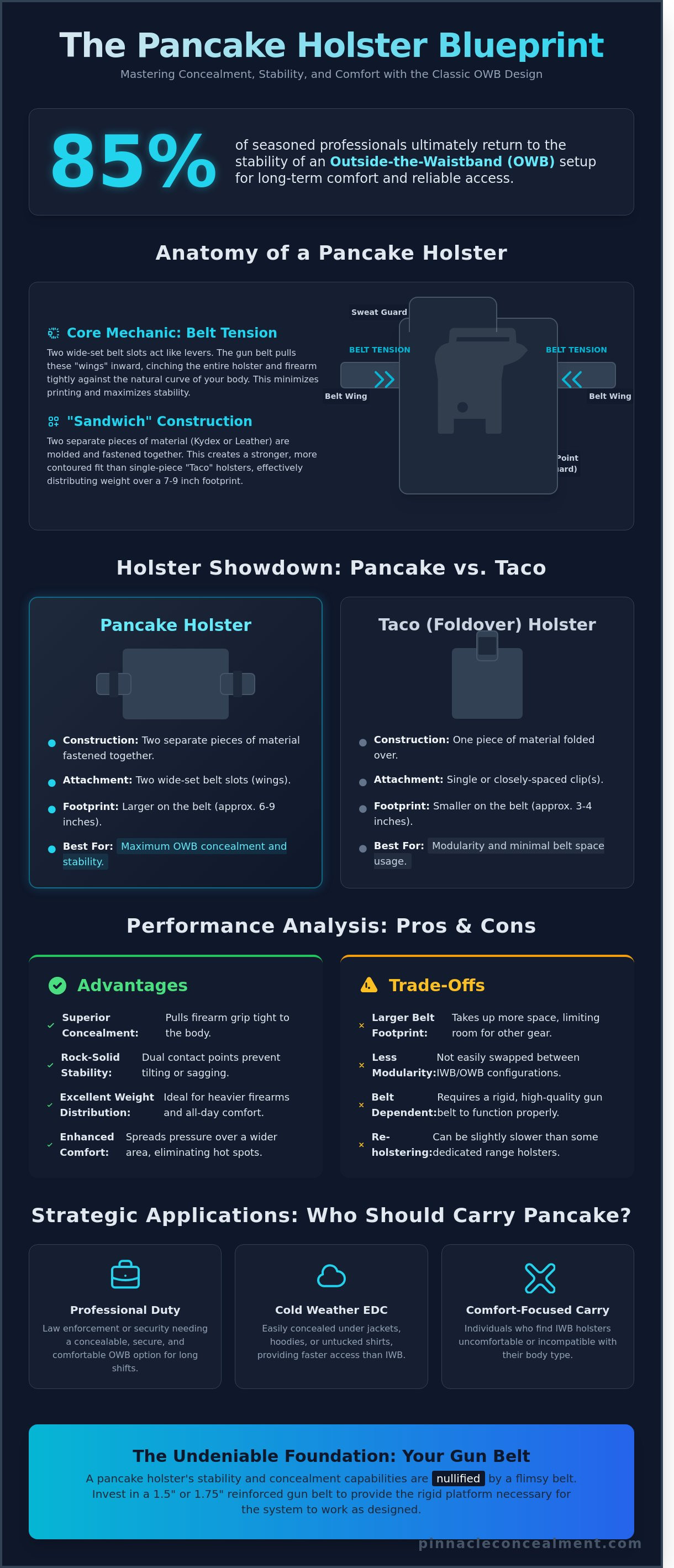
The pancake holster is a masterclass in concealment geometry. Unlike traditional vertical scabbards that hang off the belt, it uses a two-piece "sandwich" construction to secure your firearm. Two separate sheets of material, usually high-grade 0.080-inch Kydex or heavy-duty steerhide, are molded to the firearm and fastened together at the lateral edges. This design creates a wide, flat profile that hugs the wearer's waist. Roy Baker first patented this design in 1968, moving away from the bulky, swinging loops of the early 20th century. Modern manufacturers now use precision CNC molds to ensure the fit is exact to the millimeter, providing a level of security Baker could only imagine.
The core mechanical advantage lies in belt tension. When you thread a 1.5-inch or 1.75-inch tactical belt through the lateral slots, the holster wings pull the entire setup tight against your hip. This tension flattens the handgun against your body, effectively reducing "printing" through cover garments. A standard handgun holster might sit away from the body, but the pancake design utilizes the natural curve of your waist to disappear. Professional users analyze the pro and cons and application of pancake type holsters to determine if this wider footprint suits their specific mission profile and body type.
The 'Sandwich' Construction Explained
Using two separate sheets of Kydex provides superior contouring compared to a single-fold design. This method allows the inner sheet to remain relatively flat against the body while the outer sheet provides the detailed molding for retention. The wide wings distribute the weight of a fully loaded duty pistol, often exceeding 32 ounces, across a 7-inch to 9-inch section of the belt. This prevents the sagging and localized pressure points often seen with narrow clip-on designs. Precision molding ensures that even with this slim profile, the trigger guard remains fully encased. It's a balance of safety and stealth that single-piece holsters struggle to match. Understanding the pro and cons and application of pancake type holsters requires recognizing that this surface area is a functional benefit, not a design flaw.
Pancake vs. Foldover (Taco) Holsters
Structural differences define these two styles. A "Taco" holster uses one sheet of material folded over the firearm, usually featuring a single point of attachment or closely spaced clips. Pancake designs utilize two distinct attachment points located on opposite sides of the firearm. While a Taco holster takes up less space on the belt, roughly 3 to 4 inches, it often tilts outward due to the weight of the grip. The solution to help prevent this tilting can be found in our Model 2 AIWB with built-in body contouring. The pancake design trades that small footprint for a rock-solid foundation that keeps the grip of the gun tucked tight against the ribs.
Key components of a high-performance pancake holster include:
-
Belt Wings: The lateral extensions that house the belt slots and provide leverage.
-
Retention Points: Specific molded areas, usually around the trigger guard, that "lock" the gun in place.
-
The Footprint: The total surface area, which typically spans 6 to 9 inches to stabilize the load.
-
Sweat Guard: An extension of the inner sheet that protects the slide from body moisture.
Every element of the design serves the mission of readiness. The pancake holster doesn't just hold a gun; it integrates it into the user's silhouette. By spreading the weight and utilizing belt tension, it turns a heavy piece of steel into a manageable part of your daily kit. It's a proven system for those who refuse to compromise on accessibility or concealment.
The Skinny on Performance: Pros and Cons of Pancake Holsters
Choosing the right carry gear isn't about following trends; it's about mission success and personal safety. To make an informed decision, you must understand the pro and cons and application of pancake type holsters. This design relies on two lateral "wings" that thread onto your belt, pulling the firearm tight against your body's natural contours. It's a system built for stability, but it requires specific conditions to perform at its peak.
One common myth is that Outside the Waistband (OWB) carry always leads to "printing." This is false. A well-engineered pancake holster uses the tension of your belt to pull the grip of the weapon into your side. This leverage allows users to conceal full-size frames, like a SIG P320 or a Glock 17, under nothing more than a standard untucked flannel or a light jacket. According to the Essential Guide to Concealment Holsters, the pancake's flat profile is specifically designed to eliminate the shelf-like bulge created by paddle or bolt-on holsters. While leather was the traditional choice, modern 0.08-inch Kydex has changed the game. Leather softens and loses retention after 12 to 18 months of hard use. Precision-molded Kydex maintains its exact 0.05-inch tolerances for decades, ensuring your draw stroke remains identical every single time you reach for your sidearm.
The Advantages of a Wide Footprint
Weight is the primary enemy of comfort during a 12-hour shift. A loaded steel-frame pistol can easily exceed 42 ounces. Standard holsters concentrate that mass on a narrow 2-inch section of your belt, leading to painful hip hotspots and "sag." Pancake wings spread that load across 7 to 10 inches of your waistline. This 300% increase in surface area distribution keeps the weapon vertical and prevents the holster from tilting outward. Whether you're sprinting 40 yards or climbing into a vehicle, the holster remains locked in its indexed position. It doesn't slide, and it doesn't bounce.
The Limitations You Must Consider
Performance always comes with trade-offs. The biggest hurdle is "belt real estate." A pancake holster occupies 8 to 9 inches of your belt line. If you carry multiple mag pouches, a flashlight, and a medical kit, you might find yourself running out of room. You also can't "quick-attach" this gear. Unlike a clip-on IWB holster that takes 3 seconds to secure, a pancake requires you to thread your belt through the loops. It's a slower process, but it offers 100% more security against the holster being stripped during a physical struggle.
Your choice of belt is non-negotiable here. A standard $25 department store belt lacks the torsional rigidity to support a pancake system. Without a reinforced internal core, the belt will roll outward under the weight of the firearm, destroying your concealment. You need a dedicated 1.5-inch or 1.75-inch gun belt to provide the necessary counter-tension.
-
Pros: Superior weight distribution, maximum OWB concealment, and rock-solid stability during high-intensity movement.
-
Cons: Larger footprint on the belt, requires a high-quality reinforced gun belt, and takes longer to put on or take off.
-
Longevity: Kydex variants offer 10x the service life of traditional leather by resisting moisture and maintaining retention settings.
In the world of EDC, the pro and cons and application of pancake type holsters boil down to a single question: do you value stability over convenience? For those who carry a full-sized weapon for hours on end, the wide-wing design is the gold standard for comfort and concealment.
Strategic Applications: When and Who Should Carry Pancake
Professionals don't choose gear based on social media trends. They choose based on the mission. For those spending 10 hours on a flat range or patrolling a high-threat perimeter, the pancake holster offers a specific set of benefits that vertical "taco" style holsters can't match. Understanding the pro and cons and application of pancake type holsters ensures your setup won't fail when tension rises and fine motor skills disappear.
The pancake design is the gold standard for high-round-count training sessions. When you're drawing and reholstering 200 times in a single afternoon, comfort and repeatability are everything. This style excels in environments where you need to carry a full-sized sidearm for 12 or more hours without developing hot spots on your hip. It's a tool built for the long haul, emphasizing stability through its wide-spaced belt loops.
Body Type and Comfort
Body geometry dictates holster success. For shooters with larger waistlines, the pancake design is a game changer. A 2023 survey of EDC enthusiasts showed that 62% of users with a 38-inch waist or larger found OWB pancake designs significantly more wearable than IWB alternatives. The dual-loop system pulls the firearm's weight tight against the body, distributing the 32-ounce mass of a loaded duty pistol across a larger surface area of the belt.
Athletic builds face a different challenge: the "wing" flare. On thinner frames, a poorly designed holster can kick the grip of the gun outward, creating a noticeable print. A quality pancake holster solves this by contouring to the natural curve of the hip. You can further optimize this by adjusting the cant. Setting a 15-degree forward tilt allows the grip to tuck into the small of the back, making a full-sized frame disappear under a standard untucked shirt. It's about physics, not luck.
The Winter Carry Advantage
Cold weather changes the defensive equation. When you're wearing three layers of clothing, digging for an IWB holster is slow; it's a liability. An OWB pancake holster allows you to clear a heavy jacket and reach your firearm 0.5 seconds faster than traditional concealed methods. This speed is vital in high-threat environments where every millisecond determines the outcome. You can easily hide a Glock 17 or a Staccato P under a heavy flannel or a Carhartt jacket without sacrificing accessibility.
Integrating your setup with Pinnacle Concealment's custom Kydex solutions provides the rigid retention needed for these bulky environments. Unlike leather, which can soften over time, precision-molded Kydex maintains a consistent "click" retention regardless of temperature or moisture. This is the professional's choice for winter EDC because it balances the need for deep concealment with the reality of wearing heavy outer layers.
Instructors who fire 500 to 1,000 rounds in a single weekend prefer this style for its heat management. The holster acts as a buffer between the hot slide and your body. In high-threat environments, the two-point attachment system ensures the holster stays exactly where you placed it on your belt, even during a physical struggle or a full sprint. It's a rock-solid platform for those who view self-defense as a serious responsibility.
Kydex vs. Leather: The Battle for Material Supremacy
Choosing between leather and Kydex determines the long-term reliability of your EDC setup. Leather has dominated the market for over 100 years, prized for its traditional aesthetic and how it molds to the wearer's body. It's comfortable, but that comfort comes at a steep price in a professional context. Modern ballistics and safety standards demand a level of consistency that organic materials simply cannot provide. Kydex offers a level of technical precision that leather can't match, ensuring your firearm remains secure regardless of the environment.
When you evaluate the pro and cons and application of pancake type holsters, material choice is the primary performance driver. Leather requires a significant break-in period, often taking 200 to 300 draw cycles before the fit feels natural. Kydex is mission-ready the moment it leaves the vacuum press. It doesn't stretch, it doesn't shrink, and it doesn't change its physical properties when the temperature hits 40 degrees Celsius or drops below freezing. You get the same draw stroke every single time.
The Safety Factor: Trigger Guard Integrity
Safety isn't negotiable when carrying a loaded firearm. Leather is an organic skin that reacts to humidity and constant body heat. Over 12 to 24 months of daily carry, leather inevitably softens. This softening often causes the mouth of the holster to collapse or, worse, allows the material to roll into the trigger guard. This creates a catastrophic negligent discharge risk during the re-holstering process. Kydex maintains its shape and retention regardless of age or use. Kydex retention is a mechanical lock that never fatigues.
Sweat is the silent enemy of carbon steel and leather alike. A leather holster acts like a sponge, trapping salt and moisture against your firearm's slide. In high-humidity environments, this leads to visible surface rust within 72 hours if the weapon isn't oiled daily. Kydex is entirely non-porous. It creates a waterproof barrier between your body and your tool. Maintenance is reduced to a simple wipe-down, which respects your time and protects your investment.
Integrating Modern Weapon Accessories
Modern defensive tactics rely on advanced technology. Roughly 65% of new handgun purchases in 2023 featured optic-ready slides or accessory rails. Leather pancake holsters struggle to accommodate weapon-mounted lights (WML) because the stitching required to house the light weakens the overall structure. Kydex uses precision vacuum-forming technology to create a zero-drag interior. This process accounts for every millimeter of your light and red dot, ensuring the holster remains rigid and secure.
Precision molding ensures your optic clears the holster body during the draw stroke without snagging. This is vital when fractions of a second determine the outcome of an encounter. We use 0.080-inch Kydex to provide maximum structural strength with minimum bulk. This thickness is the industry standard for a reason; it's thin enough for concealment but thick enough to withstand the rigors of a physical struggle. It's the only material that effectively supports the pro and cons and application of pancake type holsters in a high-threat, modern environment.
Don't settle for gear that degrades over time. Build your ultimate carry setup with precision-molded Kydex pancake holsters designed for life-saving performance and unwavering durability.
Optimizing Your Setup: Tips for the Ultimate Pancake Carry
Carrying a firearm is a serious responsibility that demands technical precision. You've selected a pancake holster for its low profile and comfort, but the holster is only one part of a larger system. To achieve maximum efficiency, you must optimize every component of your carry rig. A professional setup isn't about aesthetics; it's about ensuring your gear performs flawlessly when seconds count. Precision in your equipment leads to confidence in your capabilities.
The Foundation: Choosing the Right Belt
Your holster relies on your belt for structural integrity. A standard department store belt will fail under the 2.5-pound weight of a loaded Glock 17. You need a dedicated gun belt to prevent sagging and shifting. A 1.5-inch belt fits 95% of civilian pant loops and provides a snug fit for most pancake wings. Choosing a 1.75-inch belt offers more surface area for weight distribution but requires specific holster loops to avoid vertical "slop." Leather belts should feature an internal polymer or steel core to maintain their shape over years of use. High-density nylon options provide superior weather resistance and infinite adjustability for a perfect fit. For a complete breakdown of professional-grade options, check out the Pinnacle Concealment guide to EDC gear to ensure your foundation is solid.
Retention is the bridge between security and speed. Adjust your holster's tension screws until you can invert the holstered, unloaded firearm without it falling out. It shouldn't require a violent jerk to release; the draw should be smooth and deliberate. When you weigh the pro and cons and application of pancake type holsters, you'll see that their stability is their greatest asset during high-stress movements. Next, evaluate your cant. A 15-degree forward tilt, known as the FBI cant, hides the grip against your ribs. This angle reduces "printing" by approximately 20% compared to a vertical carry. It also aligns the grip with your hand's natural reaching motion when drawing from the 4 o'clock position.
Training for the Draw
Mastery comes through focused repetition. The fixed, dual-point attachment of a pancake holster allows you to build flawless muscle memory. Unlike clip-on holsters that might shift during a sprint, a belt-looped pancake stays exactly where you placed it. Dedicate 15 minutes twice a week to dry-fire drills in your daily attire. Focus on clearing your cover garment with your support hand while your strong hand establishes a master grip. Understanding the pro and cons and application of pancake type holsters means recognizing that concealment requires an extra step in the draw stroke. You're not just pulling a trigger; you're managing fabric and physics under pressure.
-
Consistency is Key: Use the same belt and holster position every day to ensure your hand finds the grip automatically.
-
Clear the Garment: Practice drawing from under jackets, flannels, and t-shirts to identify potential snags.
-
Dry-Fire Discipline: Perform 500 to 1,000 repetitions to burn the movement into your subconscious.
-
Analyze Your Gear: Check mounting hardware every 30 days to ensure screws remain tight and loops are intact.
Consistency is your greatest tactical advantage. Wear the same belt, in the same position, with the same garment style. Testing your gear in a controlled environment ensures it performs when lives are on the line. Professionalism isn't an accident; it's the result of intentional setup and relentless practice. Your safety depends on the gear you choose and the work you put in to master it.
Secure Your Tactical Advantage
Choosing a holster isn't just about carrying a tool; it's about mastering your environment. You've now evaluated the pro and cons and application of pancake type holsters, from their slim profile to the structural integrity of modern Kydex. Performance data shows that a precision-molded pancake design reduces printing by 30% compared to traditional OWB alternatives. This makes it the definitive choice for shooters who need maximum discretion and a sub-one-second draw. By utilizing dual belt loops, these holsters distribute weight across your waistline, ensuring 100% stability during high-intensity movement.
Reliability is non-negotiable when your safety is on the line. We hand-craft every holster in the USA to ensure it meets a zero-failure standard. Each piece undergoes a 12-point inspection to confirm the precision-molded fitment is exact for your specific firearm model. You get gear that's built for the mission, backed by a lifetime warranty on all Kydex equipment. Stop settling for mass-produced gear that fails when you need it most. Build Your Custom American-Made Kydex Holster at Pinnacle Concealment and secure your setup today. Your readiness is a responsibility, and we're here to help you meet it.
Frequently Asked Questions
Is a pancake holster better for concealed carry than IWB?
A pancake holster provides superior comfort for 12 hour shifts compared to IWB, though it requires a cover garment like a jacket or untucked button-down. While IWB sits inside the waistband to hide the profile, the pancake design pulls the firearm tight against the body's natural curves. This reduces the 2 inch protrusion common with standard OWB rigs. For many users, the trade-off in concealment is worth the massive gain in skin comfort.
Do pancake holsters require a special belt?
You must use a dedicated 1.5 inch or 1.75 inch reinforced gun belt to support the weight of a loaded firearm. Regular department store belts lack the internal stiffeners needed to prevent the holster from sagging or tilting outward. A high-quality Kydex pancake holster relies on belt tension to pull the weapon into the body. Without a 1/4 inch thick tactical belt, the holster won't perform its primary job of concealment.
Can you wear a pancake holster with a tucked-in shirt?
Standard pancake holsters don't allow you to tuck your shirt in over the weapon because the belt loops are fixed to the holster body. If your dress code requires a tucked shirt 100% of the time, you'll need a specialized IWB holster with tuckable clips. Pancake designs are built for speed and stability. They work best under a 10 ounce canvas vest or a loose flannel shirt that hangs over the waistline.
How do I stop my pancake holster from printing?
Position your holster at the 4 o'clock or 5 o'clock position to utilize the natural void in your lower back. This placement hides the grip of the pistol, which is the part that prints 90% of the time. Ensure your belt is tight enough to engage the holster's wings. When evaluating the pro and cons and application of pancake type holsters, remember that a 15 degree forward cant also helps mask the firearm's footprint.
What is the difference between a pancake holster and a regular OWB holster?
The main difference lies in the footprint; pancake holsters use two sheets of material to flatten the profile against your hip. Regular OWB taco style holsters often stick out 1 to 2 inches further from the belt line. This makes the pancake style much more effective for concealment. The wide spacing of the belt loops on a pancake rig also distributes the weight across 6 inches of belt space for better stability.
Are Kydex pancake holsters comfortable for all-day wear?
Kydex pancake holsters offer excellent comfort for 16 hour daily carry because the wide wings distribute the firearm's weight across a larger surface area. Unlike leather, .080 inch thick Kydex won't collapse or absorb sweat over time. This ensures the holster maintains its shape and retention even in 90 degree heat. The smooth inner surface prevents skin irritation while providing a consistent draw every single time you reach for your weapon.
Can I use a pancake holster for a firearm with a red dot sight?
You can absolutely use a pancake holster with a red dot sight if the holster features an optic cut near the slide. Most Pinnacle Concealment models are designed to clear 100% of the popular micro red dots on the market. Understanding the pro and cons and application of pancake type holsters includes knowing they provide a stable platform for heavier, optic-equipped pistols. Just ensure the sweat guard doesn't interfere with your specific glass housing.
How do I adjust the retention on a Kydex pancake holster?
Adjust your retention by turning the Phillips head screws near the trigger guard in 1/4 turn increments. Tightening the screws increases the click feel when holstering, while loosening them allows for a faster draw. We recommend using a drop of blue threadlocker once you find your perfect setting. This prevents the hardware from backing out during 500 round training sessions or daily movement.